The AuctionSpain Guide
The Spanish auction system is open to anyone. Almost no foreigner uses it.
Every year, thousands of Spanish properties sell through public court auctions at 30–60% below market value. The listings are public. The portal is free. Foreigners can bid from their laptop. But the process is in legal Spanish, the rules are buried in civil procedure law, and one wrong step can cost you your 5% deposit.
This guide changes that. 304 pages. 13 chapters. Every step from NIE application to taking possession, written in plain English by people who have been through it.
One payment. Download straight after checkout.
304
pages of practical guidance
13
chapters + 6 appendices
80+
Spanish legal terms explained
€30
one payment, no subscription
Four pages, straight out of the PDF
Not mock-ups. These are pages 112, 188, 244 and 289 of the file you get, at the density you get them. Scroll sideways.
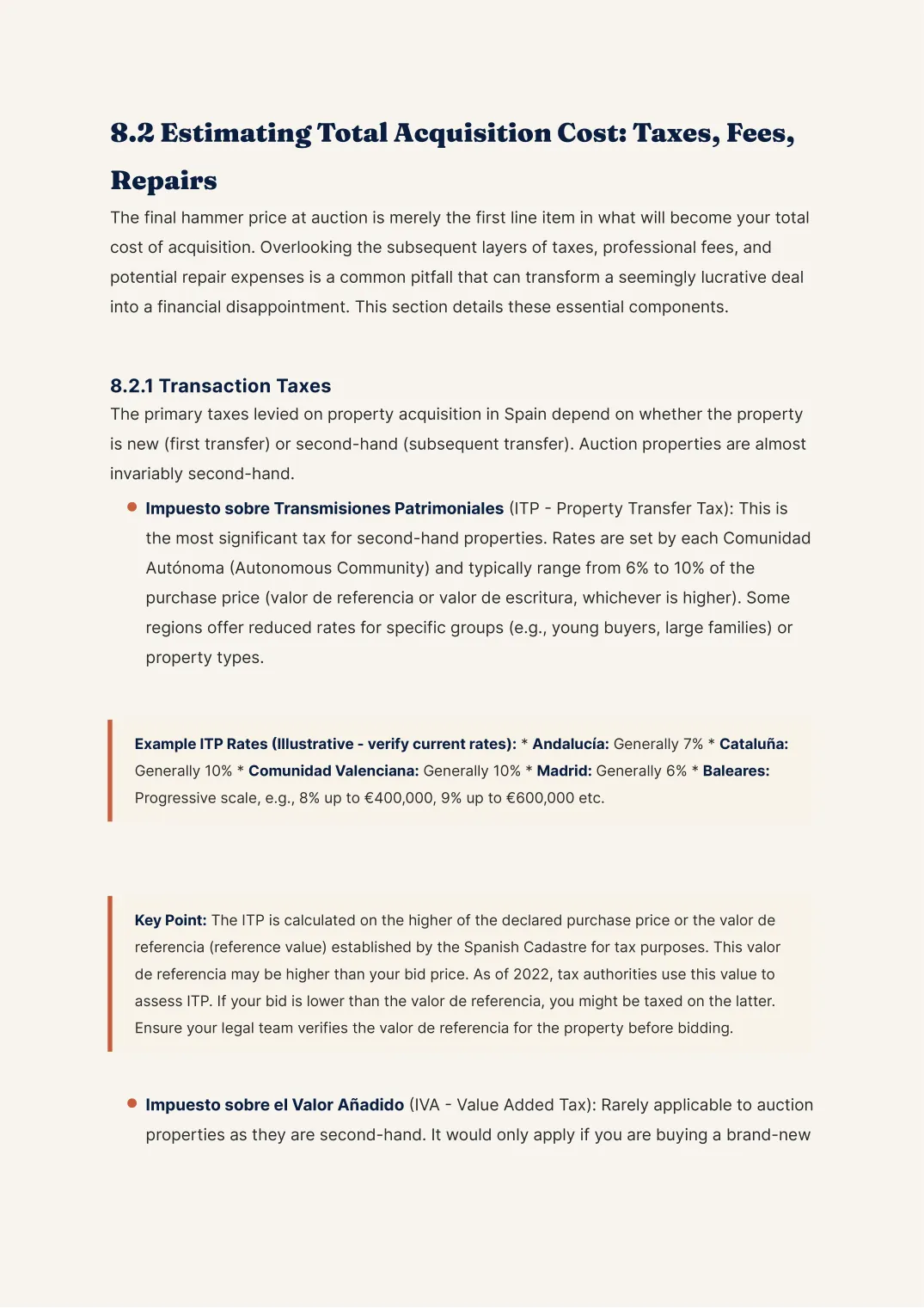
Chapter 8, p. 112
Every cost of a purchase, itemised.
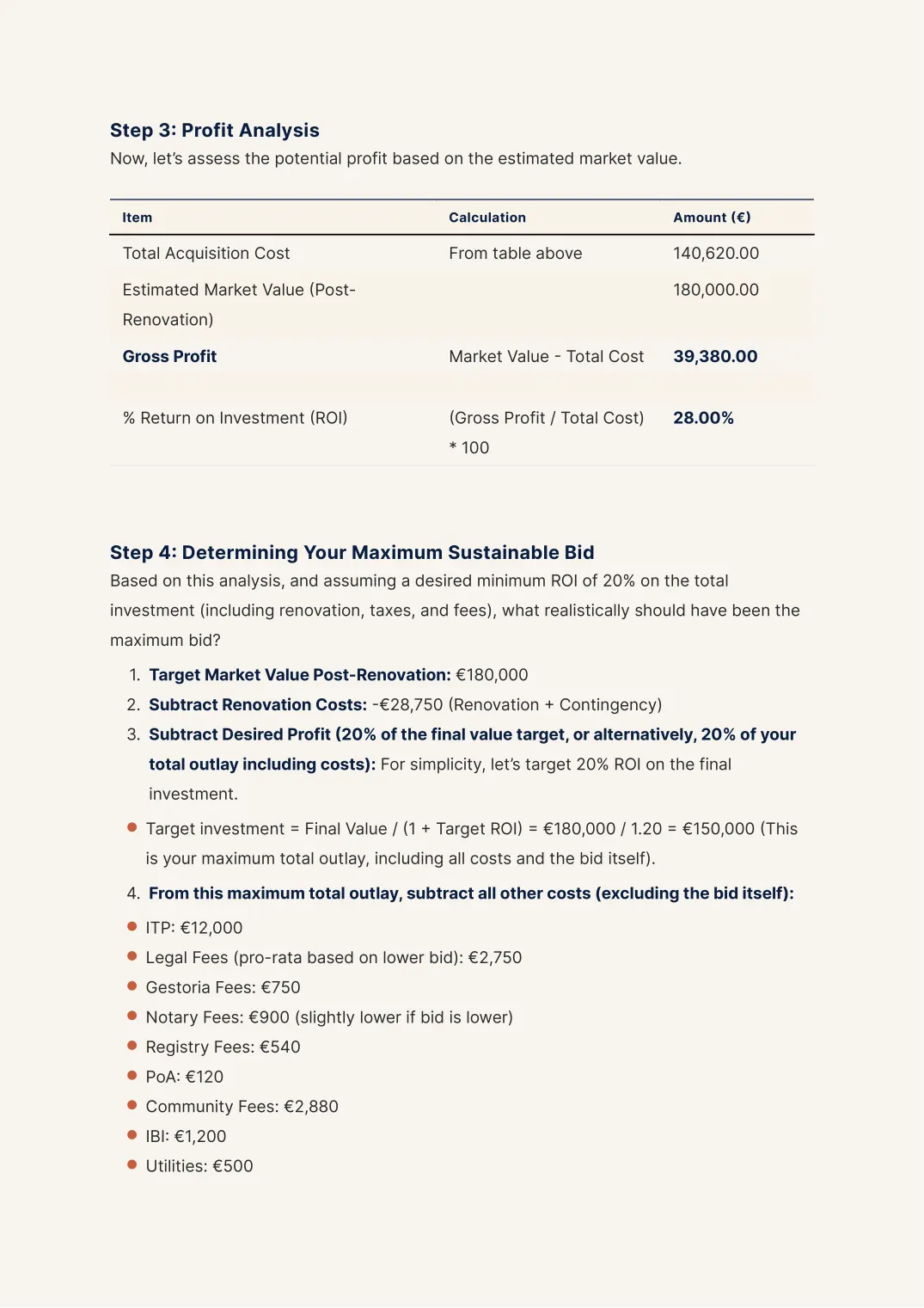
Chapter 8, p. 188
Profit analysis and your ceiling bid.
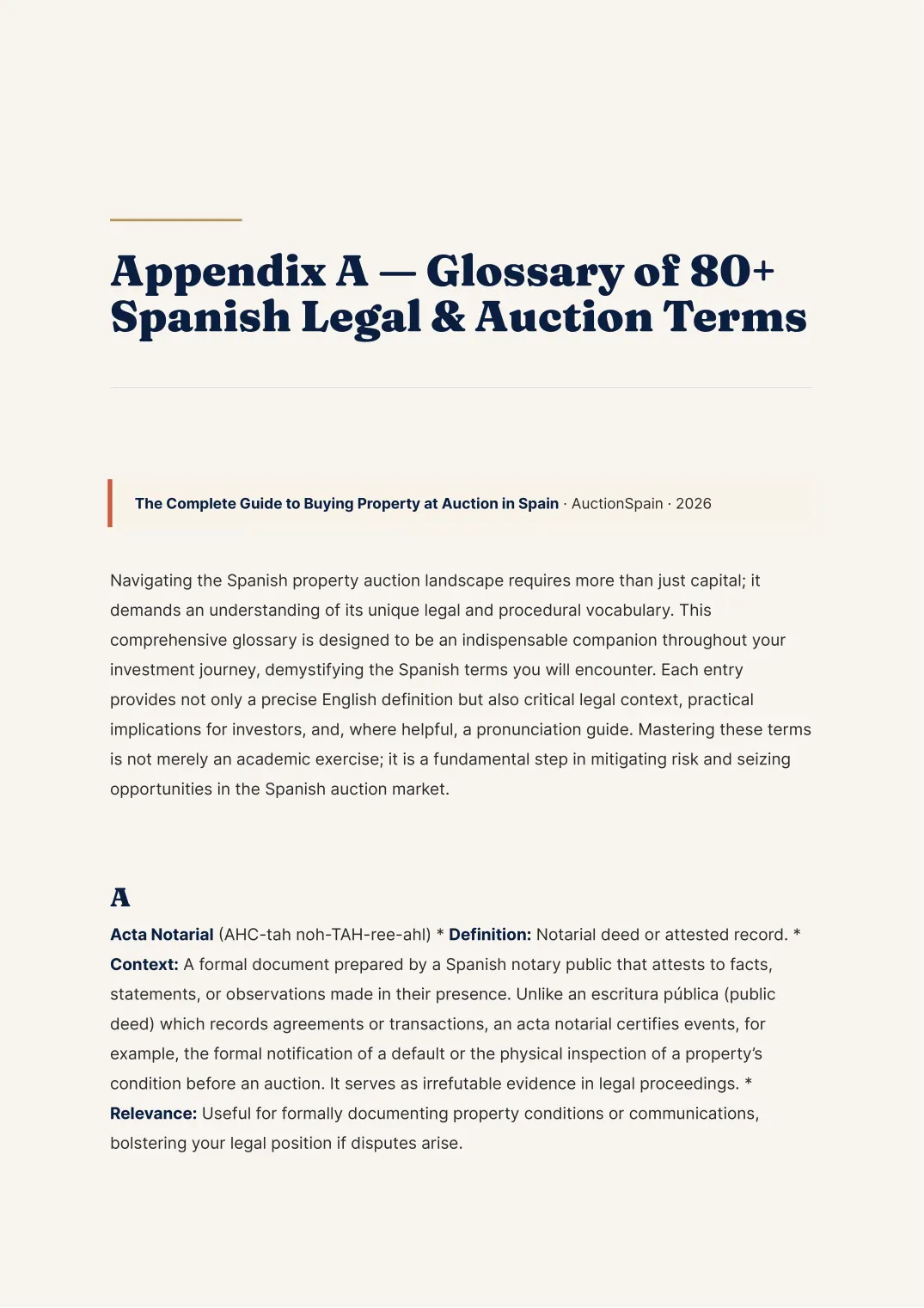
Appendix A, p. 244
80+ legal terms, defined in context.
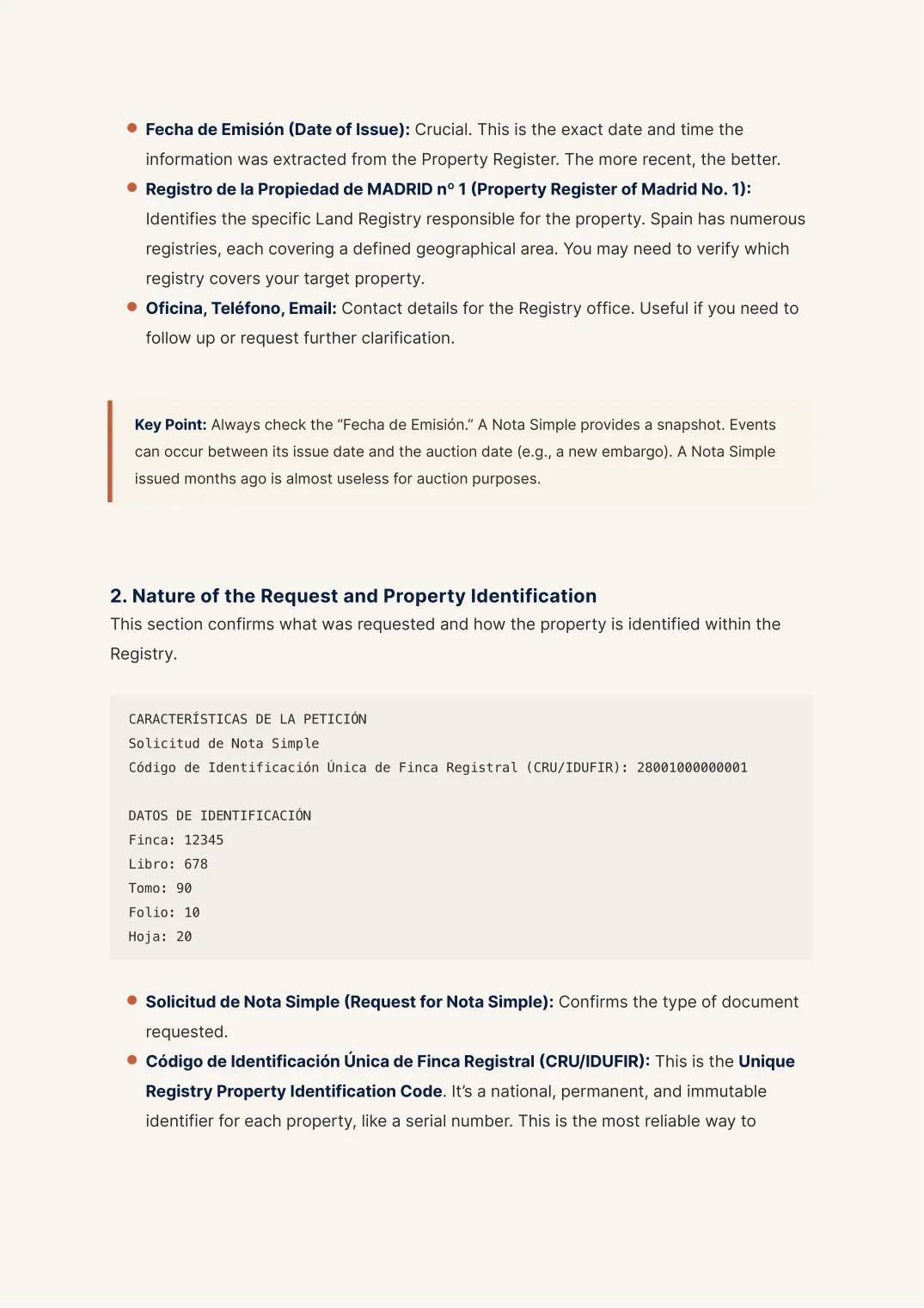
Appendix F, p. 289
A nota simple, annotated line by line.
Why most foreign buyers never act
The barrier isn't money. It's knowledge.
Spain's Portal de Subastas publishes every active judicial, tax, and notarial auction in the country. It's run by the government. It's free to access. There is no residency requirement to bid.
And yet, the overwhelming majority of foreign investors who find out about Spanish property auctions — read a few articles, maybe open the BOE portal — and then do nothing. Because the listings are in dense legal Spanish. Because they don't know what a Nota Simple is or how to read one. Because they're not sure what happens to their 5% deposit if something goes wrong. Because they don't know whether the property is occupied, and what that means in practice.
The information exists. It's just scattered across Spanish legal blogs, government PDFs, notary websites, and expat forums where half the advice is wrong.
This guide assembles all of it. In order. In English. With real numbers and real examples.
What's inside
13 chapters. Every question answered.
Part I — Understanding the Landscape
Why Spanish Auctions?
Why properties sell at 30–50% below market — and why most foreign investors never find out.
The Spanish Auction System Explained
Judicial, tax, notarial, municipal. What each type means, who runs it, and what the lifecycle looks like.
The Legal Framework
The LEC articles that govern auctions. Minimum thresholds, the 70% rule, and deadlines you cannot miss.
Part II — Preparing as a Non-Resident
Administrative Prerequisites
NIE, digital certificate, Spanish bank account, BOE registration. Step by step, from your home country.
Building Your Professional Team
Procurador, abogado, gestor. The difference, the cost, and how to bid without setting foot in Spain.
Tax Obligations for Non-Residents
ITP rates by region, IRNR, IBI, wealth tax, the 3% retention rule on sale. With real numbers.
Part III — Finding and Evaluating Properties
Research and Due Diligence
Every field in an auction listing decoded. Cargas, Nota Simple, occupancy status, community debts. Red flag checklist.
Valuation and Financial Analysis
Full cost breakdown of a real acquisition: taxes, notary, registration, repairs. When to walk away.
Part IV — Bidding and Winning
Placing Your Bid
The BOE portal screen by screen. First-day vs last-minute strategy. What the debtor can do while you bid.
You Won — Now What?
Decreto de Adjudicación, 20-day payment window, property registration, cancellation of prior charges.
When Things Go Wrong
Annulments, deposit loss, occupied properties, structural defects. Honest about the risks.
Part V — After the Purchase
Property Management from Abroad
Fiscal representative, utility contracts, insurance, renovation permits, tourist rental licences by region.
Exit Strategy
Capital gains for non-residents, plusvalía municipal, the 3% withholding. ROI scenarios for 3–5 year holds.
+ 6 Appendices
- Glossary of 80+ Spanish legal and auction terms
- ITP rates for all 17 autonomous communities (2026)
- Pre-bid due diligence checklist — 30+ items
- Power of attorney clause for remote bidding (EN/ES template)
- Official portals, registries, and tax calculators
- Sample Nota Simple annotated in English
A taste of what you'll learn
From Chapter 8: the real cost of a Spanish auction purchase
Worked example — Apartment in Seville
Chapter 8 walks through this calculation line by line — and shows you which costs vary by region, which are negotiable, and which surprises catch first-time buyers off guard.
Who this is for
Written for the non-resident investor
You've looked at Spanish property before
But the auction angle felt too complex or too risky. This guide makes it concrete enough to act on.
You're based in the UK, Germany, or northern Europe
All administrative steps account for non-residents — NIE from your home country, remote bidding via poder notarial, double taxation treaties.
You want to understand before you spend
Not ready to hire a lawyer yet. You want to know enough to ask the right questions and avoid the obvious traps.
You've been burned by vague advice
Blog posts that say 'do your due diligence' without explaining what that means. This guide explains what due diligence means, specifically, for Spanish auctions.
This guide is not for youif you're looking for a get-rich-quick formula. Spanish auctions reward patience, preparation, and a willingness to engage with an unfamiliar legal system. What this guide gives you is the preparation part.
Get the guide
€30. Less than one hour of legal advice.
A single consultation with a Spanish property lawyer costs €150–400/hour. This guide won't replace a lawyer — but it means you'll walk into that meeting knowing exactly what to ask.
The Guide
- 304-page PDF, 2026 edition
- 13 chapters + 6 appendices
- Glossary of 80+ legal terms
- Full cost breakdown with worked examples
- Bilingual power of attorney template
- Pre-bid due diligence checklist
Download link on the confirmation page, and by email
Questions
Can't I find this information for free?
Parts of it, yes. The BOE publishes every listing. The Catastro is public. Legal blogs explain bits and pieces. But nobody has assembled the complete picture in plain English — from NIE application to taking possession — with worked financial examples and real checklists. That assembly is what you're paying for.
I've never bought property at auction before. Is this too advanced?
It's written for exactly that reader. No prior experience assumed. The guide starts from first principles and builds step by step. If anything, experienced auction buyers in other markets find it most useful — because the Spanish system has specific rules that differ significantly from the UK, German or US equivalents.
Is the information current?
Yes. 2026 edition. ITP rates are current, LEC article references are verified, the BOE portal walkthrough reflects the current interface. Property law doesn't change quickly, but we will update the guide when it does.
Where do I find the actual listings?
On Spain's official Portal de Subastas, run by the BOE — free, public, and open to non-residents. We don't resell that data and we don't bid for you. Chapter 7 and Appendix E show you how to search the portal, read a listing field by field, and cross-check it against the Catastro and the Land Registry.
How is it delivered?
Payment goes through Stripe. The download link appears on the confirmation page as soon as you pay, and a copy is emailed to the address you used at checkout. If anything goes wrong, email hello@auctionspain.com and we'll send the PDF directly.
The deals are public. The knowledge doesn't have to cost thousands.
304 pages. Every step from NIE to keys in hand. Written for the non-resident investor who wants to act, not just wonder.
Download straight after checkout. No subscription.